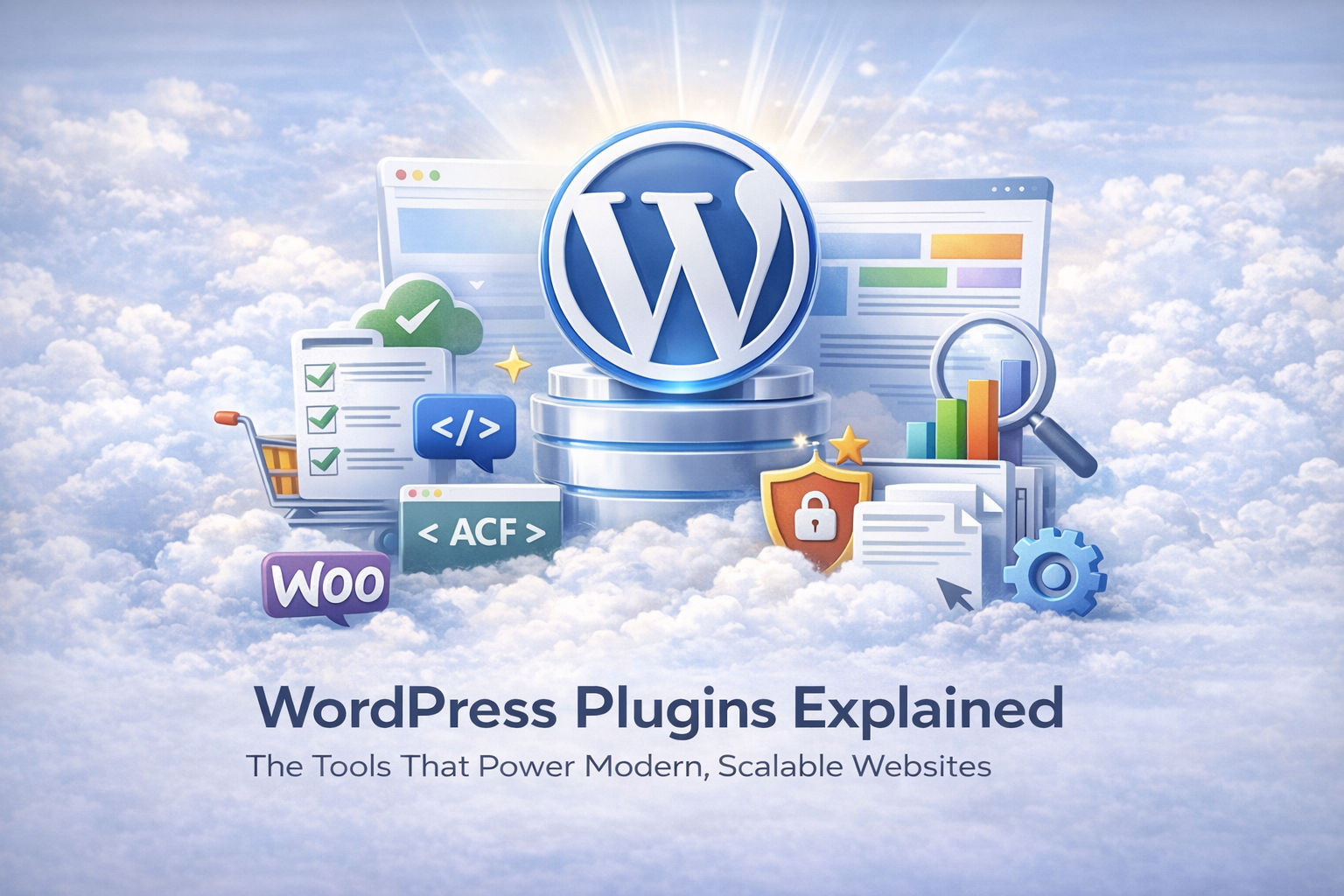
WordPress on its own is a powerful content management system—but plugins are what transform it into a professional-grade platform.
At Ascended Web, plugins are not an afterthought or a convenience feature. They are part of the underlying system design. Nearly every website we build relies on a small, carefully selected set of tools that handle structure, performance, SEO, content management, e-commerce, and long-term maintainability.
This article explains what WordPress plugins really are, how they’re used in modern development, and highlights the core plugins we rely on across most projects.
What Are WordPress Plugins?
A WordPress plugin is a modular extension that adds functionality without modifying WordPress core.
Rather than rebuilding common systems from scratch, plugins allow developers to:
-
Extend features safely and consistently
-
Keep custom functionality isolated from core updates
-
Scale systems without breaking structure
-
Maintain compatibility with future WordPress releases
Used correctly, plugins form the backbone of a stable, flexible website. Used poorly, they create fragile systems. The difference is not how many plugins are installed, but how deliberately they are chosen and integrated.
How We Use Plugins at Ascended Web
Plugins are not “extras” in our workflow. They are foundational components.
Across nearly every build, we use a consistent stack to handle:
-
SEO and structured data
-
Advanced content architecture
-
Forms, automation, and data handling
-
E-commerce and transactional workflows
-
Migrations and long-term maintenance
-
Reusable design and development components
-
System monitoring and activity tracking
We intentionally avoid bloated plugin stacks. Each tool is selected for reliability, longevity, and how well it fits into a system designed to evolve over time.
The plugins below represent the core toolkit we rely on across most Ascended Web projects, alongside additional project-specific tools when required.
Core Plugins We Use on Nearly Every Build
Rank Math
https://rankmath.com/wordpress/plugin/seo-suite/
Rank Math handles search engine optimization at a structural level.
We use it to manage:
-
Title tags and meta descriptions
-
XML sitemaps and indexing rules
-
Schema and structured data
-
Internal linking and content relationships
Rather than treating SEO as something layered on after launch, Rank Math allows optimization to be embedded directly into a site’s architecture from day one.
Advanced Custom Fields (ACF)
https://www.advancedcustomfields.com/
ACF transforms WordPress from a simple CMS into a flexible content framework.
It allows us to:
-
Create structured data fields beyond basic posts and pages
-
Build dynamic layouts for services, portfolios, and landing pages
-
Design reusable, maintainable components
ACF is central to how we build sites that scale without becoming cluttered or fragile.
WooCommerce
WooCommerce is the foundation for e-commerce, rentals, bookings, and transactional systems within WordPress.
We use WooCommerce not just for traditional online stores, but for:
-
Product and service sales
-
Rentals and date-based availability systems
-
Memberships and subscriptions
-
Payment processing and checkout flows
-
Inventory-aware workflows tied to real-world operations
WooCommerce’s strength is not just its feature set, but its extensibility. It allows complex business logic to be built directly into WordPress without forcing a site into a closed platform or proprietary ecosystem.
For businesses that need ownership, flexibility, and long-term scalability, WooCommerce remains the most adaptable e-commerce layer available on the web.
Gravity Forms
Gravity Forms is our go-to solution for anything beyond basic contact forms.
It supports:
-
Multi-step forms and conditional logic
-
CRM, email, and API integrations
-
Secure data validation and automation
-
Complex workflows such as applications, bookings, and lead routing
This makes it suitable for both customer-facing interactions and internal business processes.
All-In-One WP Migration
This plugin is part of our deployment and maintenance workflow.
We use it for:
-
Server migrations
-
Development and staging environments
-
Full-site backup and restoration
It provides a reliable way to move complete WordPress installations without manual database handling or fragile export processes.
Better Search Replace
https://wordpress.org/plugins/better-search-replace/
This utility plugin is essential for maintaining evolving sites.
We use it to:
-
Update domains during migrations
-
Correct URLs and file paths
-
Perform safe database-wide changes
It allows structural updates without corrupting serialized data or breaking system integrity.
DZ WP Options
https://ascdApps.com/dz-wordpress-options/
DZ WP Options is part of our internal development toolkit.
It provides:
-
Centralized site-wide configuration settings
-
Feature toggles and layout controls
-
Clean separation between configuration and content
This allows sites to remain flexible and maintainable long after launch.
DZ WP Avada Elements
https://ascdApps.com/dz-avada-elements/
For Avada-based projects, this plugin extends the theme with structured, reusable components.
It enables:
-
Custom design elements built into Avada’s builder
-
Reusable layout modules
-
Cleaner implementation of advanced features
This bridges visual design with development-level structure.
Stream
Stream adds system-level visibility into WordPress activity.
We use it to monitor:
-
User actions and content changes
-
Plugin and theme modifications
-
Login activity and system events
For multi-user environments and long-term maintenance, this provides accountability and operational insight.
Post Snippets
Post Snippets allows reusable content blocks to be inserted across a site.
We use it for:
-
Calls-to-action
-
Legal notices and disclosures
-
Structured content reused across multiple pages
This prevents duplication and makes global updates fast and consistent.
Why This Plugin Stack Matters
The strength of WordPress is not how many plugins it supports. It is how well those plugins are chosen and integrated.
With the right stack:
-
SEO becomes part of the site’s structure
-
Content is treated as data, not just text
-
E-commerce adapts to real business workflows
-
Features evolve without rebuilding the site
-
Maintenance becomes predictable instead of fragile
This is how WordPress scales from a simple website into a long-term business system.
Final Thoughts
At Ascended Web, plugins are not shortcuts. They are building blocks.
The tools listed above form the foundation of nearly every site we build. They allow us to deliver websites that are structured, maintainable, and capable of evolving over time without accumulating technical debt.
The difference between a fragile site and a scalable one isn’t how many plugins are installed. It’s whether those plugins are part of a deliberate, well-architected system.