Why WordPress is STILL the Superior Choice for Building a Website
Choosing the right platform is one of the most important decisions you’ll make when building a website. It affects everything: how flexible your site is, how well it performs in search, how easily it can grow, and how much control you retain over your own system.
Over the years, dozens of website builders have come and gone. Some promise speed. Others promise simplicity. A few promise “all-in-one” convenience. Yet one platform has remained dominant across personal sites, business websites, and large-scale digital properties:
WordPress.
Despite new competitors and changing design trends, WordPress continues to stand out as the most capable, adaptable, and future-proof option for serious websites. Here’s why that’s still true today.
Why the Platform Matters More Than the Design
A website is not just a collection of pages. It’s a system.
The platform you choose determines:
-
How much control you have over structure and functionality
-
Whether your site can scale as your business grows
-
How easily you can optimize performance and SEO
-
Who truly owns your content and data
Some platforms are designed for speed of setup. Others are built for long-term flexibility. If your site is meant to be more than a temporary presence—if it needs to evolve, integrate with tools, or support custom workflows—the underlying system matters just as much as the visual design.
What Makes WordPress Different
WordPress is an open-source content management system (CMS) that powers a massive portion of the web. Unlike closed platforms, WordPress gives you full access to your site’s structure, content, and code.
That openness creates three major advantages:
1. True Customization
WordPress can be molded to fit nearly any use case. From small informational sites to advanced e-commerce systems, custom applications, and publishing platforms, WordPress adapts to the project—not the other way around.
2. Ownership and Portability
You are never locked into a vendor. You control your hosting, your domain, your data, and your files. If you want to move your site, change providers, or rebuild components later, you can.
3. Ecosystem and Longevity
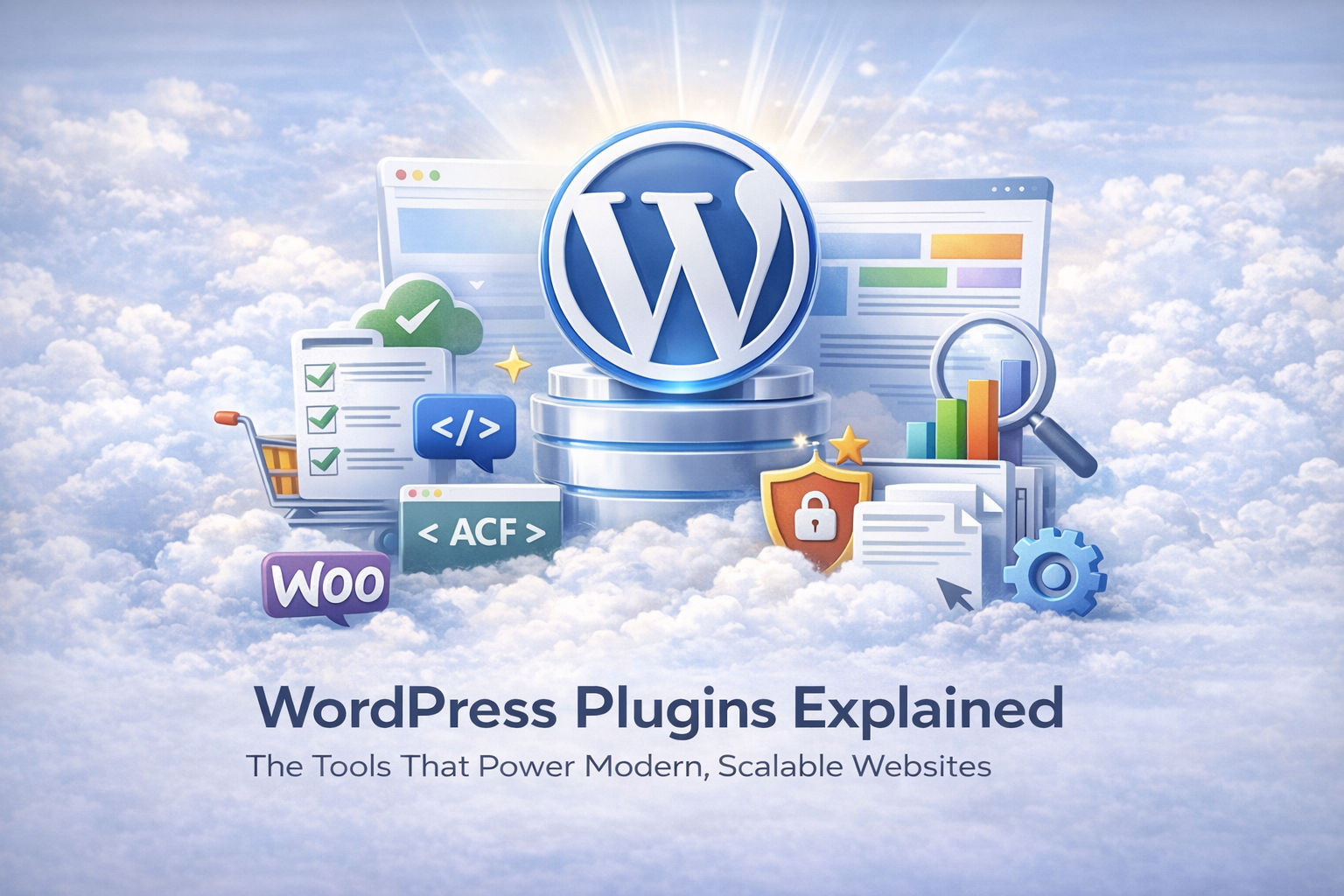
With decades of development and a global community behind it, WordPress is constantly evolving. Its massive plugin and theme ecosystem allows features to be extended without reinventing the wheel, while still supporting custom development when needed.
How WordPress Compares to Website Builders
Many modern builders prioritize ease of use: drag-and-drop editors, bundled hosting, and simplified interfaces. These tools are attractive for quick projects, but they come with tradeoffs.
Closed Platforms
Most website builders operate as closed systems. They provide templates, hosting, and built-in tools, but limit access to the underlying structure. That means:
-
Custom features are restricted or impossible
-
Advanced SEO and performance tuning are limited
-
You are tied to their pricing model and infrastructure
-
Migrating later can be costly or require rebuilding from scratch
For simple, short-term websites, this can be fine. For businesses that want flexibility, integration, and long-term control, it becomes a constraint.
WordPress as an Open System
With WordPress:
-
You can extend functionality with plugins or custom development
-
You can optimize performance at the server and code level
-
You control hosting, caching, security, and backups
-
You can redesign or restructure without replacing the entire platform
Instead of fitting your business into a predefined box, WordPress lets your website grow organically with your needs.
Search Visibility and SEO Control
Search visibility is not determined by design alone. It depends on structure, performance, indexing, and content organization.
WordPress gives you full control over:
-
URL structures and permalinks
-
Metadata, headings, and on-page optimization
-
XML sitemaps and indexing behavior
-
Schema and structured data
-
Performance and load times
This makes it possible to build SEO into the foundation of the site rather than layering it on as an afterthought.
While many website builders offer basic SEO settings, they rarely provide the depth of control needed for technical optimization, large content libraries, or long-term authority building.
E-Commerce and Advanced Functionality
For sites that need more than static pages—booking systems, membership platforms, calculators, automation, or online stores—WordPress offers unmatched flexibility.
Through platforms like WooCommerce and custom development, WordPress can support:
-
Product catalogs and payment processing
-
Subscriptions and memberships
-
Custom workflows and integrations
-
Scalable content and data systems
Rather than forcing your business into predefined features, WordPress allows functionality to be built around your actual processes.
Cost, Value, and Long-Term Economics
WordPress itself is free. Costs come from:
-
Hosting
-
Premium themes or plugins (optional)
-
Development and maintenance
In contrast, many website builders charge monthly fees that bundle hosting, tools, and features into a subscription model. While convenient at first, those costs compound over time—especially as your site grows or requires additional capabilities.
More importantly, with WordPress you are paying for infrastructure and expertise—not access to your own website. You are investing in something you own.
Why WordPress Still Wins
WordPress is not just popular—it is resilient.
It remains the superior choice because it:
-
Adapts to almost any type of website
-
Scales without forcing platform migrations
-
Supports advanced SEO and performance optimization
-
Preserves ownership and avoids vendor lock-in
-
Continues evolving with modern web standards
Whether you’re building a business website, a publishing platform, or a complex application, WordPress provides a foundation that can grow with you rather than limit you.
Final Thoughts
The question is not whether WordPress is “easy” or “modern.” It is whether your website needs to be flexible, scalable, and fully yours.
For projects that matter long-term, WordPress remains the most capable and future-proof platform available. Trends will continue to change. New tools will come and go. But a system built on ownership, extensibility, and structure will always outlast shortcuts.
That is why WordPress is still the superior choice.