Search engine optimization is often discussed as a single discipline, but in practice it breaks down into two very different areas of work: on-page SEO and off-page SEO. Both influence how a site is ranked, how it is interpreted by search engines, and how effectively it attracts qualified traffic. They also operate in very different ways.
This article walks through the fundamentals and the more advanced layers of each, and explains how they work together to shape long-term search performance.
What Is On-Page SEO?
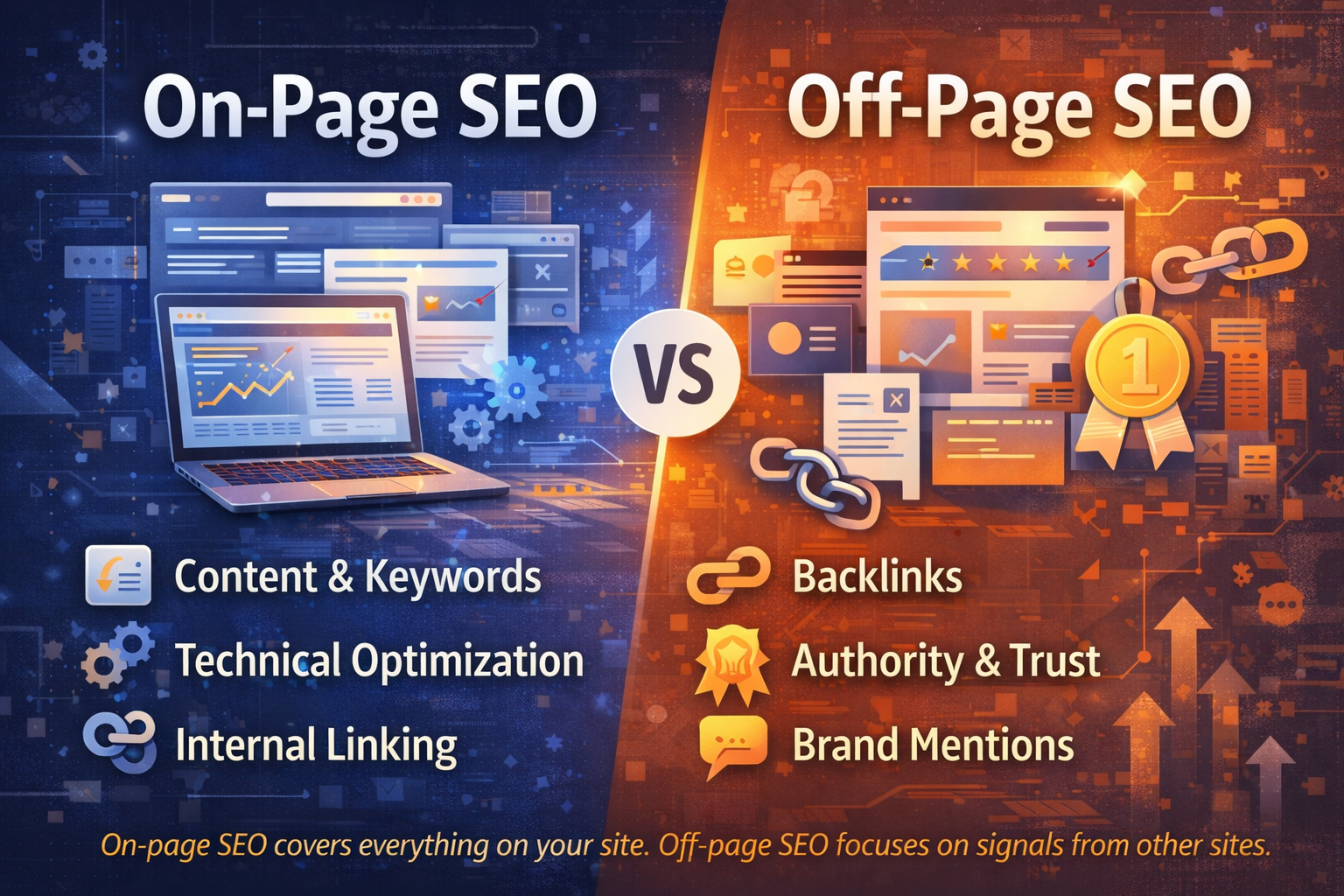
On-page SEO refers to everything that happens within your website. It includes how pages are written, structured, formatted, and technically delivered to users and search engines. This is the portion of SEO that you control directly.
At its core, on-page SEO answers one question for search engines: What is this page about, and how useful is it to someone searching for this topic?
On-Page SEO: The Basics
At a foundational level, on-page SEO is about clarity and relevance.
Search engines evaluate:
-
Page topics and language
The words on the page signal what the content covers. Clear, descriptive writing that aligns with user intent allows search engines to categorize the page accurately. -
Headings and structure
Titles, headings, and subheadings create a hierarchy that communicates how information is organized. This improves both readability and crawlability. -
Metadata
Title tags and meta descriptions shape how pages appear in search results and help search engines understand context. -
Internal linking
Linking between related pages strengthens topical relationships across your site and improves indexation. -
Usability and formatting
Readable layout, appropriate spacing, accessible navigation, and logical flow all support engagement, which indirectly reinforces content quality.
In short, basic on-page SEO ensures that your site is understandable, navigable, and aligned with what people are actually searching for.
On-Page SEO: Advanced
Advanced on-page SEO moves beyond keywords and formatting into technical and semantic territory.
This includes:
-
Search intent mapping
Structuring content based on what users are trying to accomplish (research, comparison, purchase, learning) rather than simply targeting phrases. -
Structured data (schema)
Adding machine-readable markup that helps search engines interpret meaning, relationships, and content types. -
Performance optimization
Load speed, rendering efficiency, image handling, and caching all affect how search engines evaluate user experience. -
Content depth and topical authority
Pages that comprehensively address a subject within a broader, well-organized content ecosystem tend to perform better long-term. -
Accessibility and semantic markup
Clean HTML structure, meaningful tags, alt text, and logical navigation improve both usability and search engine interpretation.
Advanced on-page SEO is not about tricking algorithms. It is about building pages that are technically sound, semantically clear, and genuinely useful.
What Is Off-Page SEO?
Off-page SEO refers to signals that originate outside your website. These signals help search engines assess credibility, authority, and trustworthiness.
If on-page SEO is what you say about yourself, off-page SEO is what the rest of the web says about you.
Off-Page SEO: The Basics
At a basic level, off-page SEO centers on links and visibility.
Search engines look at:
-
Backlinks
When another site links to your page, it acts as a vote of relevance. Not all links are equal. Context, source credibility, and topical alignment matter far more than quantity. -
Brand mentions
References to your business or content, even without direct links, help establish presence and legitimacy. -
Referral traffic
If users are arriving from other sites and engaging meaningfully, it signals real-world relevance.
Off-page SEO develops naturally when content is valuable, cited, and shared in appropriate contexts.
Off-Page SEO: Advanced
Advanced off-page SEO focuses on long-term reputation rather than link accumulation.
This includes:
-
Authority building within a niche
Earning mentions and citations from trusted industry sources, educational organizations, publications, and recognized platforms. -
Content syndication and editorial coverage
Being referenced in original reporting, research, or authoritative resources strengthens topical trust. -
Digital PR and outreach
Strategic relationship building with relevant publishers, communities, and professional networks. -
Link profile health
Monitoring the quality, diversity, and context of inbound links to ensure growth remains organic and credible.
Modern off-page SEO is less about “getting links” and more about being a legitimate, referenced resource in your field.
How On-Page and Off-Page SEO Work Together
Neither on-page nor off-page SEO operates effectively in isolation.
Strong off-page signals cannot compensate for weak, unclear, or poorly structured content. Likewise, technically perfect pages with no external recognition will struggle to compete in competitive search environments.
On-page SEO establishes:
-
Relevance
-
Structure
-
Usability
-
Clarity of purpose
Off-page SEO reinforces:
-
Authority
-
Trust
-
Credibility
-
Real-world validation
Search engines evaluate both simultaneously. Pages that perform well over time tend to demonstrate consistency across both domains.
Where Many SEO Strategies Fail
The most common SEO mistakes are not technical. They stem from misunderstanding what search engines are trying to reward.
Pages fail when they:
-
Focus on surface-level optimization without depth
-
Chase backlinks without earning relevance
-
Publish content that adds no original value
-
Ignore site performance, structure, or accessibility
Sustainable SEO is not built on shortcuts. It is built on clarity, quality, and credibility.
Final Thoughts
On-page SEO defines what your website is.
Off-page SEO defines how the internet perceives it.
Both are essential. Both evolve. But the underlying principle remains unchanged: search engines aim to surface the most relevant, reliable, and useful results for users.
When your site is structurally sound, content-driven, and genuinely valuable to its audience, both on-page and off-page SEO align naturally over time.