Client Spotlight: The Pono Foundation
Originally published as a launch article · Updated for Ascended Web
The Pono Foundation is a Hawaii-based nonprofit dedicated to education, community support, and long-term impact across the islands. While the organization originally focused on drug-abuse awareness, its mission has evolved into a broader educational model serving two core audiences: youth and seniors.
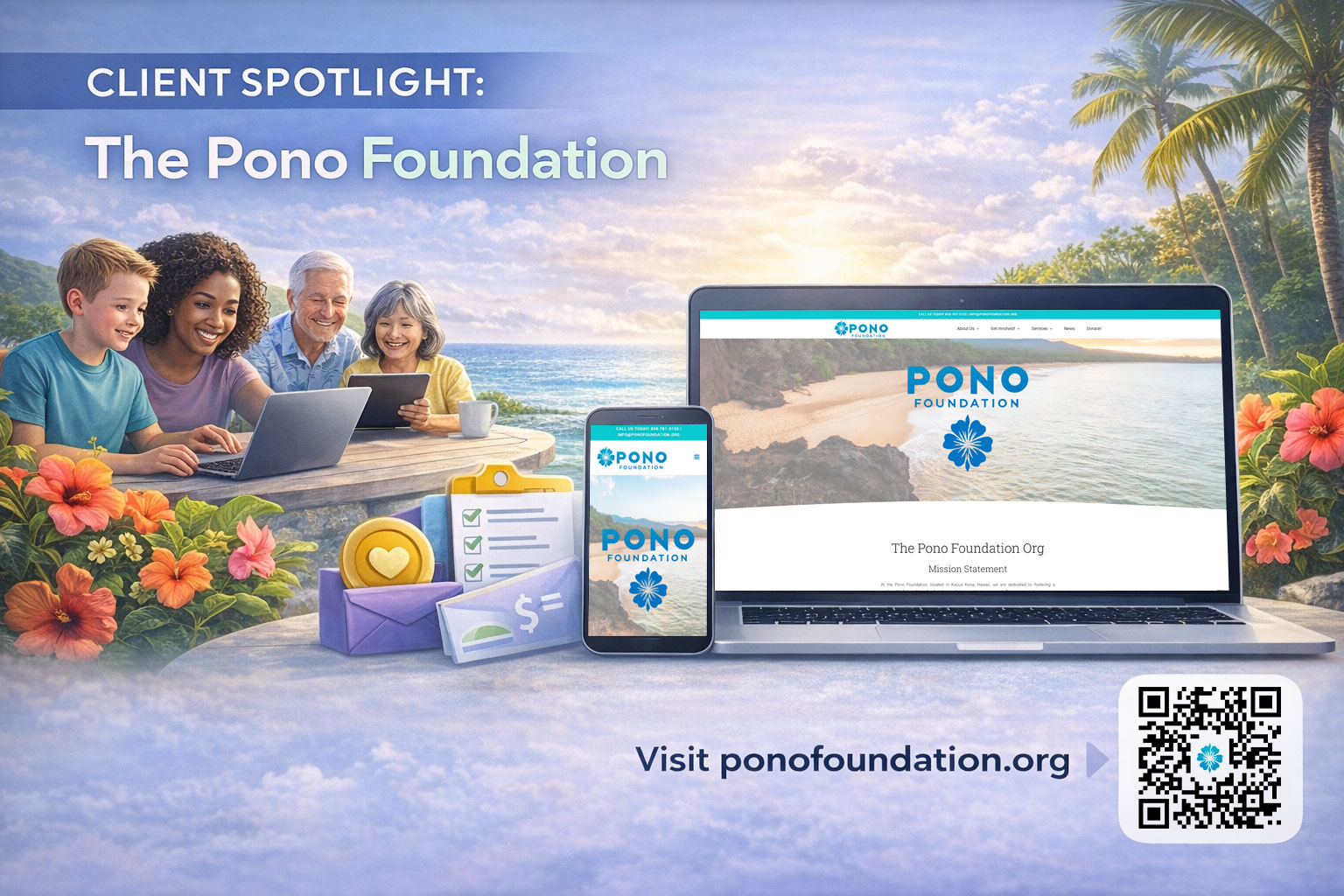
This Client Spotlight looks at how the Pono Foundation website was designed and developed to support that shift, providing flexible systems for programs, resources, donations, and outreach without sacrificing clarity or accessibility.
A Platform Built for Education
From the beginning, the goal of the site was not just to present information, but to function as an educational platform.
The organization runs multiple initiatives throughout the year, including:
-
Community education programs
-
Youth-focused learning and enrichment events
-
Senior outreach and digital literacy initiatives
-
Fundraising campaigns and donor programs
The website needed to support these evolving efforts while remaining easy to manage and accessible to a wide age range of users.
Designing for Multiple Audiences
One of the defining challenges of this project was balancing very different user groups.
The site had to be intuitive for:
-
Students and families seeking educational opportunities
-
Seniors accessing community programs and resources
-
Donors looking to contribute or subscribe
-
Partners exploring collaboration through the Foundation’s network
The structure was designed to present information clearly without overwhelming visitors, emphasizing readability, navigation, and a calm, approachable visual hierarchy.
Custom Development: Screening, Donations, and Community Tools
Several features required custom development beyond a standard nonprofit website build.
Nationally Accepted Screening Tool
A DAST-10 based screening survey was developed and integrated directly into the site. This allowed the Foundation to provide an educational self-assessment tool in a secure, accessible format without relying on third-party platforms.
Donation and Subscription Systems
Custom donation and recurring support pages were built to streamline fundraising while maintaining transparency and ease of use for contributors.
Community Network Directory
The Foundation’s network page was developed as a structured resource hub, allowing organizations and partners to be presented in a way that supports discovery, collaboration, and long-term growth.
Each of these systems was designed to function as part of the overall platform rather than as disconnected add-ons.
Data-Driven Local Relevance
A signature feature of the site is Kona Today, a real-time data module that displays sunrise and sunset, moon phases, and tidal information. While subtle, this feature reinforces the Foundation’s connection to place and environment, aligning with its educational focus on both technology and nature.
More importantly, the site architecture was built to support:
-
Clean indexing for educational content
-
Modular expansion as new programs are added
-
Long-term maintainability without vendor lock-in
Supporting a Growing Mission
As the Foundation’s focus expanded beyond its original scope, the website needed to evolve with it. Rather than rebuilding each time priorities shifted, the platform was structured to accommodate new initiatives through flexible content systems and scalable design patterns.
This ensures that future programs, events, and educational resources can be added without disrupting the site’s foundation.
The Outcome
The Pono Foundation website now operates as a living system rather than a static brochure. It supports:
-
Educational outreach for youth and seniors
-
Community engagement through structured resources
-
Secure screening and assessment tools
-
Fundraising and donor relationships
-
A digital presence that reflects the organization’s long-term mission
Most importantly, the platform gives the Foundation the ability to grow its impact without technical barriers.
Final Thoughts
Nonprofit websites must do more than look professional. They must educate, serve diverse audiences, and remain adaptable as missions evolve.
The Pono Foundation project is a strong example of how thoughtful web design and development can support real-world education, outreach, and community building over time.
Visit the site here:
https://ponofoundation.org/