Some projects are about launching a website.
Others are about building a system that has to work in the real world.
Kona Mobility Scooters is firmly in the second category.
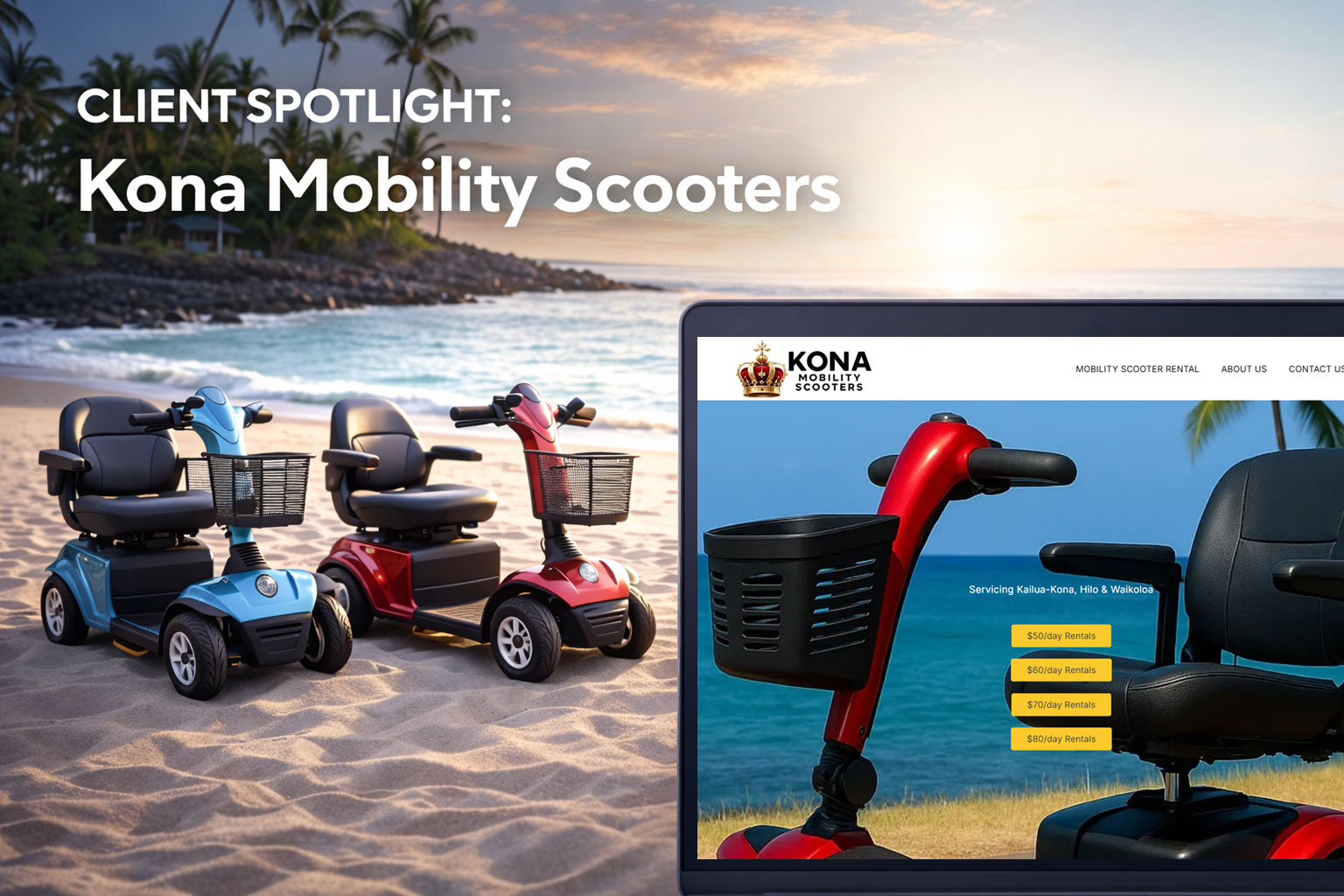
Based in Kailua-Kona, Hawaii, Kona Mobility Scooters provides mobility scooter and power wheelchair rentals for visitors and local residents across the Big Island. The website was not just a marketing presence—it needed to function as the core of the business, handling bookings, availability, and customer experience for people planning travel from thousands of miles away.
This project became one of the most involved builds we’ve ever taken on, and a defining example of how we approach web design and development when a website has to do real work.
The Challenge
From the beginning, the site needed to serve a very specific audience. Many visitors were traveling to Hawaii and arranging mobility support in advance. Others were local residents who needed a reliable rental solution quickly. That meant the site had to be simple to navigate, easy to use on mobile, and absolutely clear about what was available and how reservations worked.
At the same time, this was not a standard e-commerce setup. Kona Mobility Scooters does not sell products—it rents equipment for specific time periods. The system had to reflect that reality accurately: availability by date, multiple units per item, and a booking experience that felt intuitive rather than transactional.
This was not a case where a theme and a few plugins would be enough.
Designing for Real Use
The design approach focused on clarity over decoration. Every layout decision was made with the end user in mind: people planning travel, coordinating accessibility needs, or trying to reserve equipment quickly from a phone.
The site was built to be responsive from the start, with a mobile-first layout that keeps navigation simple and the booking process easy to follow. Accessibility, readability, and performance were not treated as afterthoughts. They were built directly into the structure of the site.
The goal was not just to make the site look professional, but to remove friction at every step.
Building a Rental System, Not a Store
The development work is where this project truly came to life.
Rather than forcing a traditional shopping cart into a rental business model, the booking system was structured specifically around how mobility rentals actually work. Availability had to be tied to date ranges, inventory needed to be tracked across multiple units, and the checkout process had to remain simple for customers while still supporting the operational needs of the business.
Under the hood, this required custom logic and careful system design. What appears on the surface as a straightforward booking flow is backed by a platform built to handle scheduling, inventory management, and real-world usage without confusion.
This is the kind of development that turns a website from a brochure into an operational tool.
“Kona Today”: A Custom Feature Built for the Island
One of the most distinctive parts of the site is a custom homepage feature called Kona Today.
Rather than relying on generic widgets or third-party embeds, this module was built from scratch to display real-time environmental data that is actually useful to visitors on the Big Island. It presents sunrise and sunset times, moonrise, moonset, the current moon phase, and the day’s high and low tides. It also includes a visual chart that shows the approximate height of the tide throughout the day.
From a development perspective, this required integrating multiple data sources, formatting them for clarity, and presenting them in a way that added value rather than visual noise. It is not decorative—it is functional.
It is a small detail, but one that reflects how we approach custom development: if something is going to exist on a page, it should serve a real purpose.
Beyond the Browser
What made this project truly unique is that it extended far beyond the website itself.
To make the business operational, the equipment had to exist in the real world. Sourcing mobility scooters and power wheelchairs that could be shipped to Hawaii is not straightforward. It required coordinating logistics, freight shipping from California, and physically preparing the equipment so it could be delivered safely and reliably.
While that level of involvement is not something we advertise as a standard service, it speaks to the way we approach projects when the system we are building has to function beyond the screen. The website was only one part of the infrastructure. The business had to work end-to-end.
Why This Project Matters
Kona Mobility Scooters represents what modern web development should look like when a site is expected to support a real service business.
The design prioritizes clarity and accessibility.
The development is purpose-built around how rentals actually operate.
The underlying systems were created to be stable, maintainable, and scalable.
This was not a “launch it and forget it” website. It was a platform built to support ongoing operations, customer trust, and long-term growth.
A Foundation for the Future
Client Spotlight is not about showcasing features for the sake of features. It is about documenting how thoughtful design and disciplined development translate into systems that work in the real world.
Kona Mobility Scooters is a clear example of that philosophy in action: a website that is not only visually clean, but structurally sound, operationally capable, and built to serve people who rely on it.