Search Engine Optimization, or SEO, is one of the most common topics clients ask about. Everyone wants to know how to show up on the first page of Google. As you might expect, the answer is not simple. Search algorithms evolve constantly, and anyone practicing SEO professionally must stay current.
That said, there are foundational principles that have remained consistent for years. This article focuses on those timeless fundamentals—the parts of SEO that continue to matter regardless of algorithm updates or industry trends.
The Two Pillars of SEO
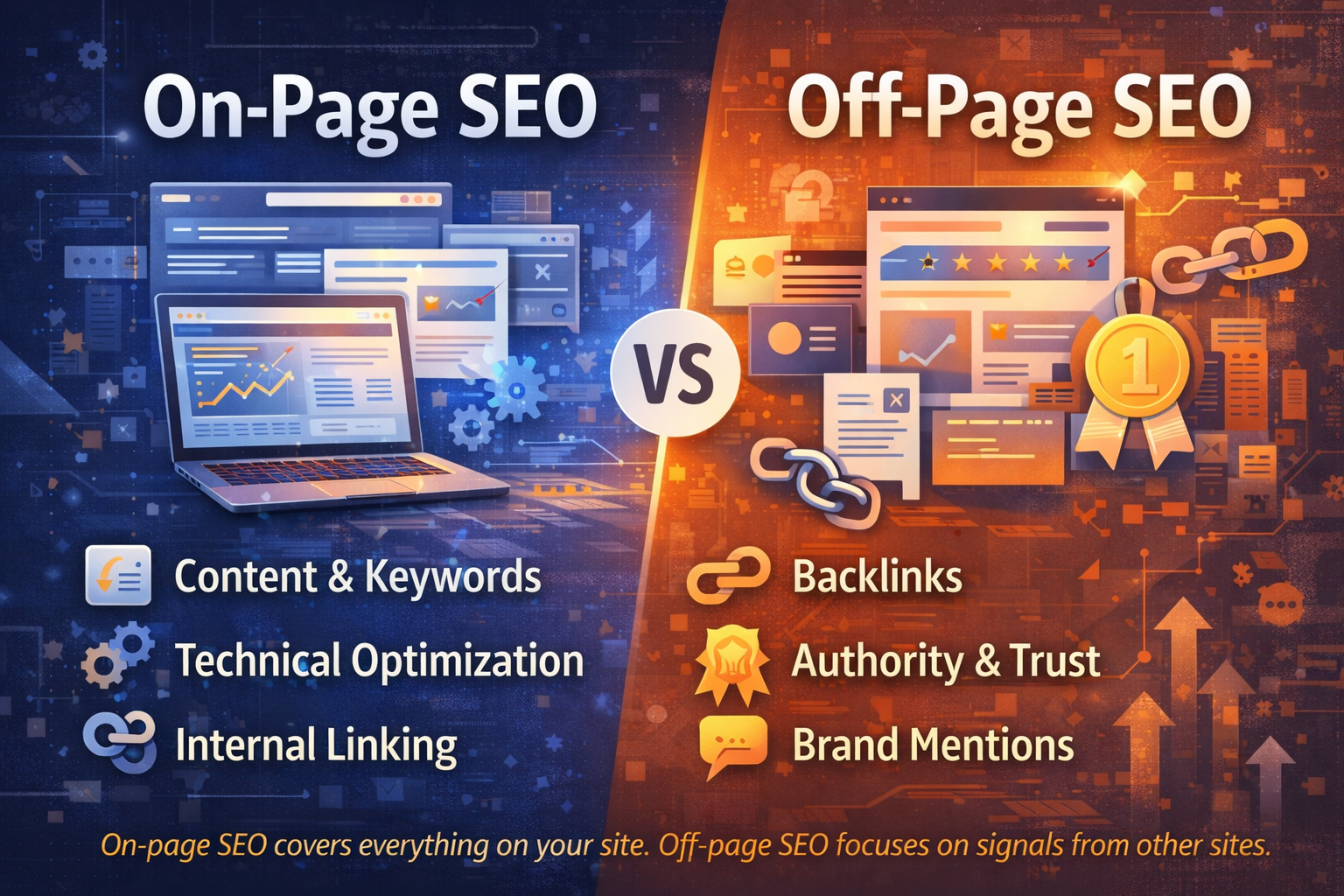
SEO can be broadly divided into two categories:
-
On-Page SEO – Everything on your website that influences how search engines understand and rank your content
-
Off-Page SEO – External signals that reflect how the internet at large views your site
We will start with On-Page SEO, because it is entirely within your control.
On-Page SEO: What You Control
Every page on your website communicates information to search engines. Your text, structure, headings, formatting, and internal links all contribute to how your content is categorized and ranked.
Search engines are trying to understand:
-
What your page is about
-
Who it is for
-
How it is different from similar content
Clarity, relevance, and structure are the foundation.
Your Site Has a Reputation
Each website, and each individual page, develops a reputation over time. Search engines assess how clearly you define your topic, how useful your content is to users, and how consistently you deliver value.
On-page SEO is effectively what you are saying about yourself. It does not work in isolation, but it gives search engines the context they need.
Titles and Headings Matter
The most important text on any page is found in:
-
Page titles
-
Headings (H1, H2, H3, etc.)
-
Introductory paragraphs
Search engines treat these as structural signals. Titles tell them what the page is about. Headings clarify the subtopics. Clear, descriptive wording improves both search visibility and user comprehension.
Descriptive, Relevant Content
Well-written body content is not filler. It provides context, depth, and clarity. Search engines analyze how thoroughly you cover a topic, how clearly you differentiate your subject from similar pages, and whether your content aligns with what users are actually searching for.
Formatting also plays a role:
-
Emphasized text (bold, links) signals importance
-
Internal links help define structure and relevance
-
Logical paragraph order improves topical flow
Speed and Technical Performance
Search engines prioritize pages that load quickly and function smoothly. Performance is not only a user experience factor—it directly affects indexing, crawling, and ranking.
Fast, well-optimized sites tend to perform better because they:
-
Reduce bounce rates
-
Improve accessibility
-
Provide a better experience across devices
Modern SEO includes performance optimization, image compression, caching, clean code, and efficient hosting.
What No Longer Works
Many tactics that once influenced rankings are now ignored or actively penalized. These include:
-
Hidden text or keyword stuffing
-
Meta keyword tags (no longer used by major search engines)
-
Irrelevant keyword insertion
-
Manipulative formatting intended to deceive crawlers
Search engines are designed to detect artificial manipulation. Attempts to “game” the system typically harm credibility rather than improve it.
Off-Page SEO: What Others Say About You
If On-Page SEO is what you say about yourself, Off-Page SEO is what others say about you.
The most important component is your backlink profile—the links from other websites pointing to yours.
Search engines treat links as signals of credibility and relevance. However, not all links are equal.
Why Backlinks Matter
Links from reputable, authoritative websites carry far more weight than links from unknown or low-quality sources. Search engines evaluate:
-
Where the link comes from
-
The relevance of the linking site
-
The context of the link
-
The wording used in the link
A single high-quality backlink from a trusted site can outperform dozens of low-quality links.
On-Page Before Off-Page
Backlinks work best when your site already communicates clear topical relevance. If your pages are well-structured and clearly focused, external links reinforce your positioning. Without that foundation, search engines lack the context needed to interpret those signals correctly.
Marketing, PR, and Visibility
At its core, SEO is closely tied to marketing and public relations. Search engines reward:
-
Genuine brand visibility
-
Earned mentions and references
-
Meaningful engagement from relevant audiences
Strong content, real partnerships, and consistent outreach create the kinds of signals that algorithms are designed to detect.
Social Platforms as Public Presence
While social media does not directly influence rankings, it plays an indirect role by:
-
Increasing content exposure
-
Encouraging sharing and linking
-
Supporting brand recognition
Consistency matters more than volume. A predictable, reliable presence builds trust with both users and platforms over time.
How AI Fits Into Modern SEO
Artificial intelligence has changed how content is created, but it has not changed what search engines ultimately reward.
AI can accelerate drafting, research, formatting, and technical optimization. It can help identify gaps, summarize large datasets, and streamline workflows that once took hours. In that sense, it has become a powerful tool in modern SEO.
What it does not replace is originality, expertise, or real value.
As AI-generated content becomes more common, search engines have become better at distinguishing between pages that exist to rank and pages that genuinely help users. Content that is generic, repetitive, or produced without meaningful insight rarely performs well over time—regardless of how it was created.
AI does not replace authority.
It does not create trust.
It does not earn citations, mentions, or backlinks on its own.
Used responsibly, AI improves efficiency and consistency. Used carelessly, it produces noise. The fundamentals remain unchanged: publish content that answers real questions, structure it clearly, make it fast and accessible, and build credibility through quality and relevance.
In other words, AI is an amplifier—not a shortcut.
Conclusion
Search engine optimization is not about tricks, shortcuts, or chasing algorithms. It is about:
-
Clear structure and meaningful content
-
Technical performance and accessibility
-
Credibility built through relevance and trust
-
Consistent, honest marketing
There is far more depth to SEO than any single article can cover, but the principles outlined here remain the foundation. Websites that perform well in search are not manipulating systems—they are providing value, communicating clearly, and earning recognition over time.
That has always been true, and it continues to be true today.